The Buttermilks: Climbing, History & a Guide to Buttermilk Country
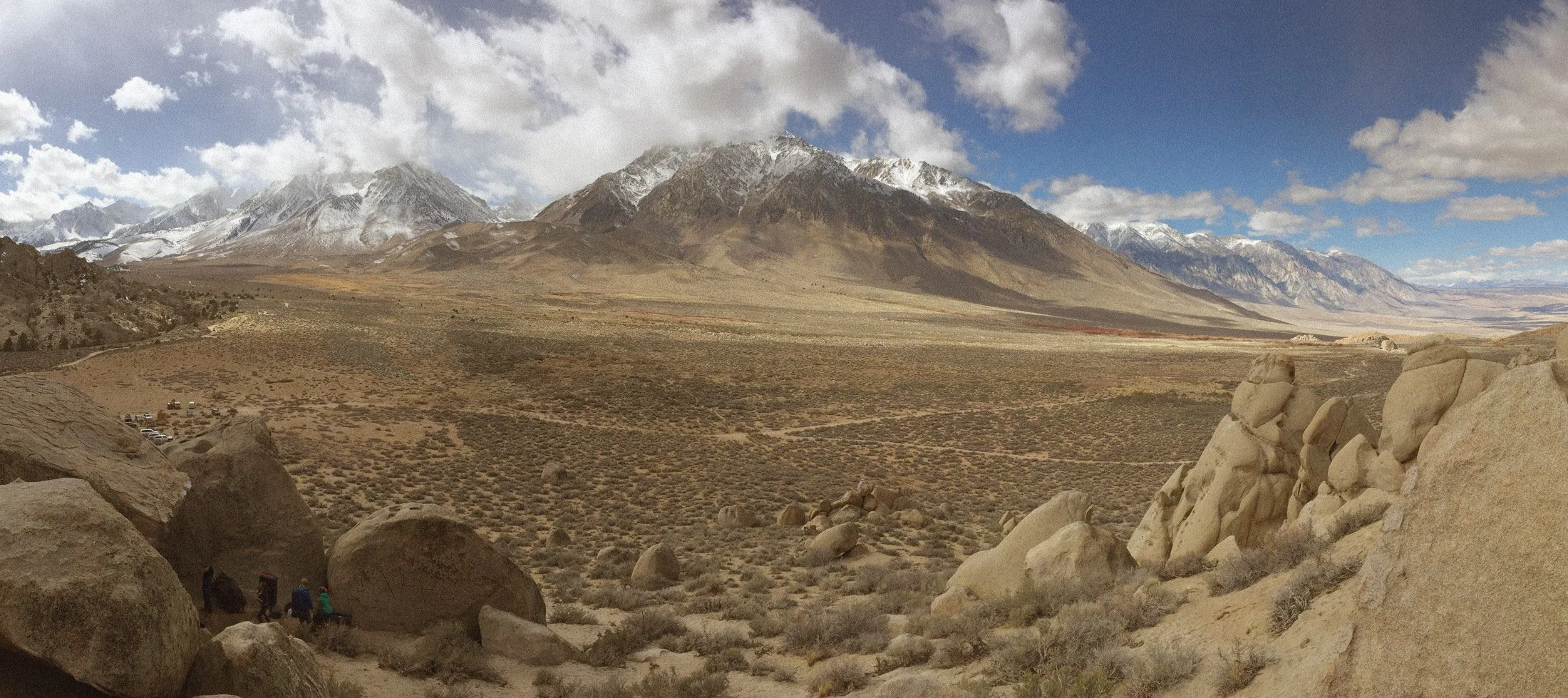
Buttermilk Country near Bishop, California. Photo: Kunstee / CC BY 2.0. Cropped and edited.
West of Bishop, California, the Owens Valley begins to tilt toward the Sierra Nevada. Highway 168 leaves town and climbs toward the mountains before reaching Buttermilk Road, an unpaved turnoff into the open country below the Sierra escarpment. Follow it for a few miles and enormous blocks of granite begin appearing across the high-desert bench, some large enough to look less like boulders than pieces of the mountains behind them.
Today, the Buttermilks are one of the best-known bouldering areas in the United States. Climbers come to Bishop from around the world for the coarse granite, famous highballs and cold-weather conditions. The climbing sits within a much longer history, beginning with the Indigenous people of the Owens Valley and continuing through ranching, mining, early Sierra mountaineering and Bishop’s development into a modern climbing town.
Even the boulders have a story that is still being worked out. Long described as glacial erratics, some of the largest blocks may have reached the bench through massive rockslides instead.
And then there is the word Buttermilking, coined decades before crash pads and V-grades entered the picture.
The Buttermilks: At a Glance
| Location | West of Bishop, California |
| Elevation | About 6,300–6,400 ft. at the main climbing area |
| Best Known For | Granite bouldering and highballs |
| Best Season | Fall, winter and early spring |
| Prime Conditions | Cool, dry days |
| Access | Buttermilk Road from Highway 168 |
| Road Conditions | Unpaved; snow, washboarding and ruts can affect access |
| Facilities | Pit toilet at the Birthday Boulder parking area |
| Expect | Busy weekends and major holidays during climbing season |
Visit Bishop places the first parking area at 6,280 feet, about 2,100 feet above Bishop on the valley floor. That elevation difference becomes important when deciding where—and sometimes whether—to climb on a given day.
Before There Were Climbers
Buttermilk Country lies within the traditional homeland of the Owens Valley Paiute, in a landscape where Indigenous communities lived, gathered food and managed water long before roads reached the Sierra foothills. Historical and archaeological sites remain throughout the region, and visitors are asked to leave artifacts where they find them and avoid publicizing sensitive locations.
The familiar Buttermilk name appears much later. An Inyo County backroads guide traces it to the 1870s and a dairyman known as “Old Joe” Inman. Workers from a nearby sawmill reportedly stopped at his dairy during the summer for cold buttermilk.
A second explanation has survived as local folklore. According to that version, the road between the dairy and Bishop was so rough that milk carried over it was practically churned into buttermilk along the way. Anyone who has spent enough time on washboarded Eastern Sierra dirt roads can appreciate why the story stuck. Historical accounts give the dairy explanation firmer footing, while the rough-road version has circulated for decades in its own right.
Eventually, Buttermilk became the name for the road, the surrounding country and, among climbers, the enormous boulders beneath the Sierra.
Smoke Blanchard Goes Buttermilking
William “Smoke” Blanchard came to Bishop in the early 1940s and became a fixture of Eastern Sierra mountaineering. He climbed with Norman Clyde, worked as a mountain guide and later directed the Palisades School of Mountaineering. His interests extended well beyond difficult climbing. Smoke favored what he called “mild mountaineering,” an approach built around moving through the mountains with relatively little equipment and plenty of attention to the country around him.
Between larger mountain trips, Smoke and other climbers spent days moving through the crags and boulder fields west of Bishop. They scrambled moderate fifth-class terrain, climbed cracks, mantled onto blocks and linked formations together. In a 1990 American Alpine Club memorial, his friend John Fischer remembered these outings by the name Smoke gave them: “Buttermilking.”
The activity predates the modern idea of bouldering as a collection of individual problems with established names and grades. The boulder field itself was the objective, and moving through it could serve as practice for larger mountain routes. Fischer remembered Smoke approaching climbing as what he called “Picnic and Pilgrimage,” where physical challenge and an appreciation of the landscape belonged to the same day.
Long before Bishop became an international bouldering destination, climbers were already spending their days among these rocks simply to climb, scramble and move through the landscape.
Today, “Buttermilking” reads more like a piece of Bishop climbing history than everyday climbing slang. Its survival preserves something of the culture that existed here before the Buttermilks became internationally known.
From Mild Mountaineering to Highballs
By the late 1960s, climbers were pushing farther onto the huge blocks that now define the Buttermilks.
Climber and writer Doug Robinson recalled arriving at the Peabody boulders in 1969 and climbing a roughly 70-foot line with protection. He later discovered that Smoke’s son, Bob Blanchard, had already soloed it and apparently hadn’t considered the ascent especially noteworthy.
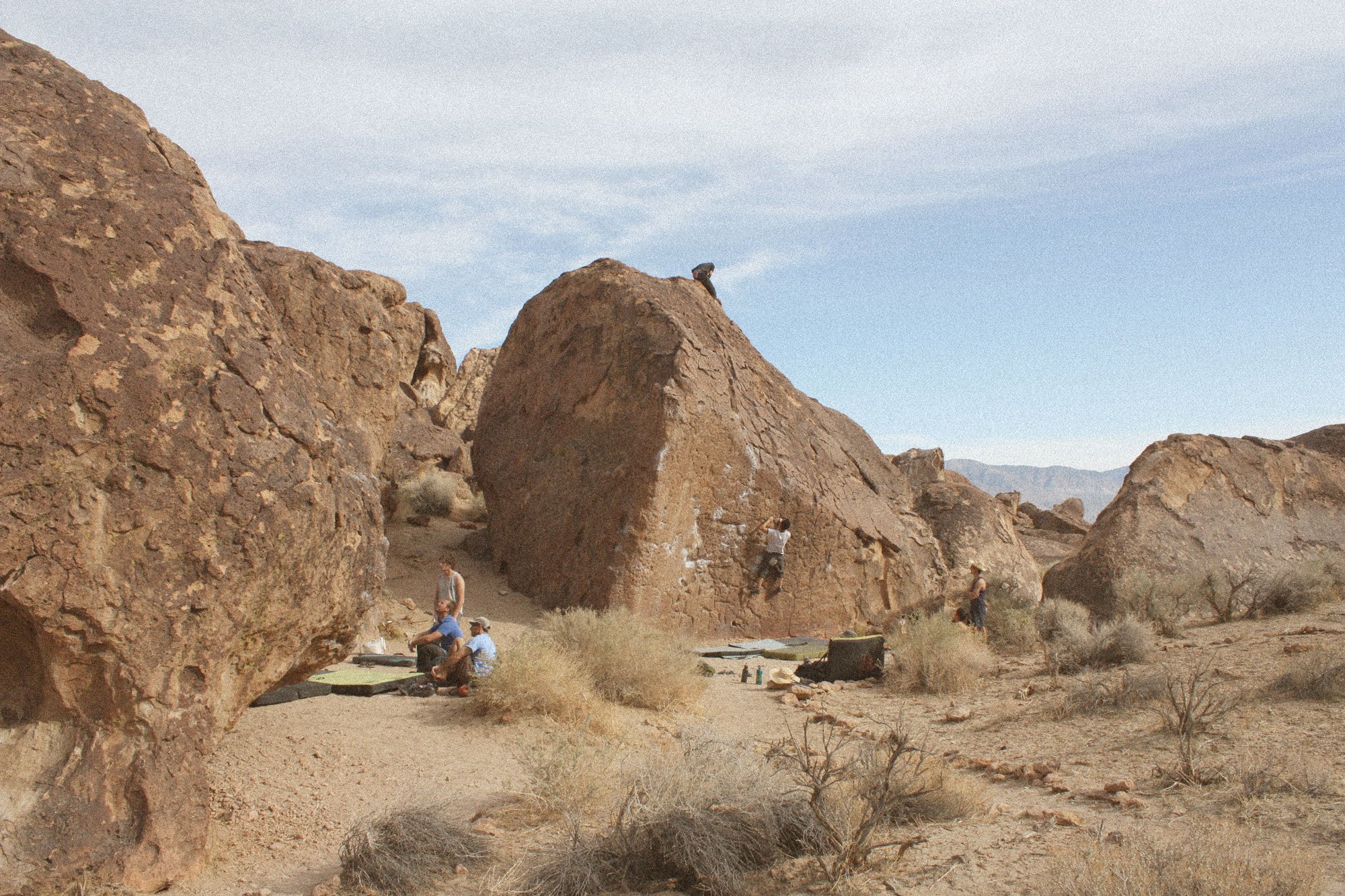
Bouldering at the Buttermilks, Bishop, California. Photo: Mark Doliner / CC BY-SA 2.0. Cropped and edited.
Robinson’s story comes from a period when the boundaries between scrambling, soloing and bouldering were much less defined than they are today. Climbers were already moving high above the ground on the Peabodys and other formations, sometimes using ropes and sometimes climbing without them.
Over the following decades, individual lines acquired names and grades, and bouldering increasingly became an objective of its own. The arrival of crash pads changed how climbers approached landings and falls. Bishop developed a reputation for the highball: a boulder problem tall enough that falling near the top carries consequences beyond those of an ordinary problem.
Height remains part of the character of the Buttermilks. Local climbing organizations warn that many problems are highballs and that some descents require care of their own.
Modern climbers also pushed the area’s technical difficulty. Chris Sharma established The Buttermilker in 1999, a V13 that became one of the better-known hard problems of its era. The Peabodys and surrounding formations continued attracting climbers interested in both difficulty and height, helping turn Bishop into an international winter destination.
What began as a place for mild mountaineering had become one of the defining landscapes of American bouldering.
How Did the Buttermilks Get Here?
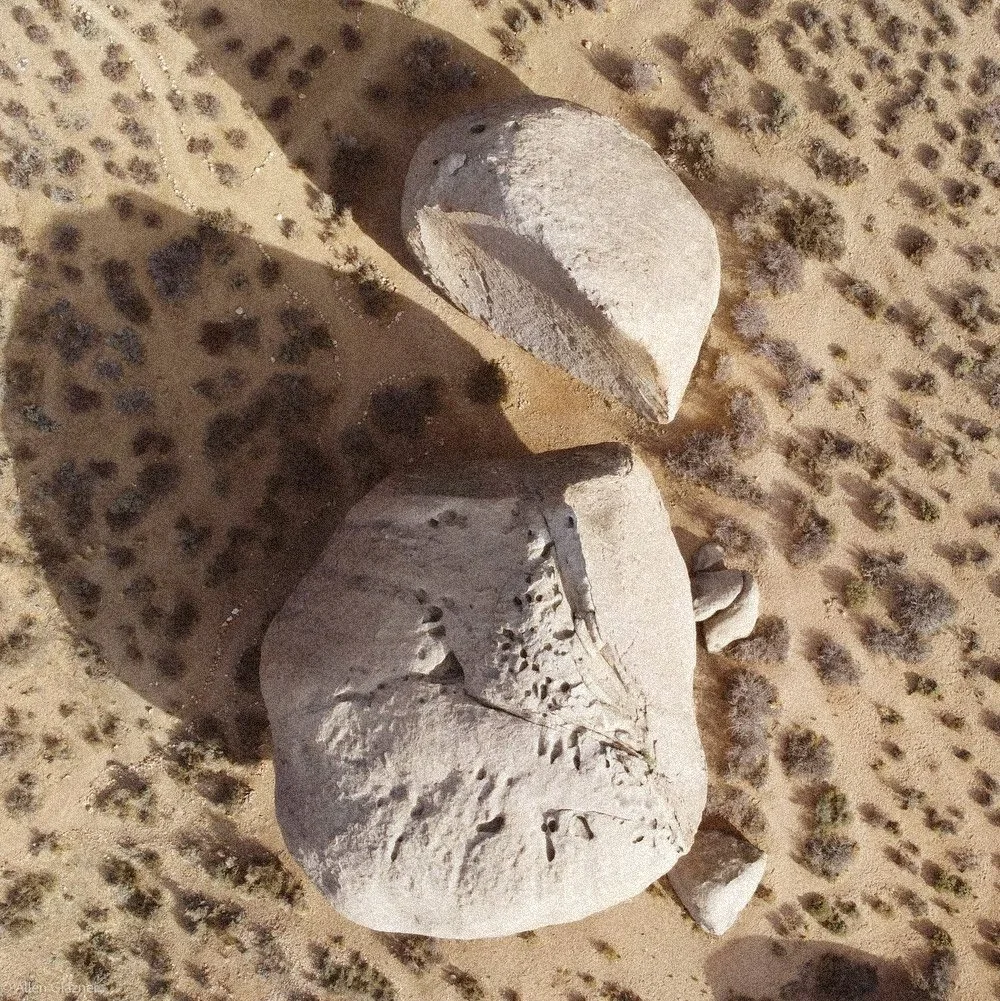
Grandpa and Grandma Peabody Boulders, Buttermilk Country. Photo: Allen Glazner. Used with permission.
The giant blocks themselves raise a surprisingly unsettled geological question.
They are commonly described as glacial erratics, deposited as glaciers moved out of the Sierra. More recent research proposes a different origin for at least the principal Buttermilk boulders.
In 2022, geologists Allen Glazner, Robert Harrington and Arthur Sylvester presented research to the Geological Society of America arguing that the blocks originated locally and moved downslope from bedrock above. Their evidence includes similarities between the boulders, the underlying bedrock and the cliffs upslope, along with physical evidence of movement and crushed rock beneath the blocks.
The scale involved is difficult to appreciate from photographs. According to their reconstruction, the Peabody boulders once formed a single mass approximately 15 meters tall, 20 meters wide and 27 meters long before separating along a natural joint.
The researchers also raised the possibility that large earthquakes helped send some blocks downslope, connecting the landscape to the active fault systems responsible for events such as the 1872 Lone Pine earthquake.
The rockslide interpretation remains a scientific proposal, so the origin of the boulders shouldn’t be treated as settled. It does, however, complicate the familiar glacial-erratic explanation. Some of the rocks climbers travel thousands of miles to climb may be enormous pieces of the Sierra that broke loose above the valley and moved downslope under gravity, possibly assisted by violent seismic shaking.
When to Climb the Buttermilks
Fall, winter and early spring make up the primary climbing season at the Buttermilks. As the Owens Valley warms later in the year, much of the Eastern Sierra climbing season moves toward Rock Creek and eventually into the high country.
Temperature matters because bouldering depends heavily on friction. Cooler conditions generally improve the relationship between skin and rock, while dry air helps keep hands from becoming sweaty. Climbing-shoe rubber is temperature-sensitive as well. Very warm rubber becomes softer; extreme cold can make it too stiff. For most climbers, the goal is a cool, dry day rather than the lowest temperature possible.
The Buttermilks’ elevation and exposure add another variable. Conditions can differ noticeably from Bishop only a few miles away.
Fall: The Season Returns
October and November bring climbers back down from the high Sierra as temperatures begin falling across the Owens Valley. Cooler granite and dry high-desert weather can make this one of the easier periods for planning a Buttermilks trip, before winter storms complicate road access.
It is also the beginning of Bishop’s busy climbing season. Weekends bring more traffic, and Thanksgiving is one of the periods when climbing areas and campsites can become heavily crowded.
Winter: Cold Rock and Good Friction
Winter is central to Bishop’s reputation as a climbing destination. On a clear day, the high desert can be dry and sunny while the Sierra above is covered in snow. Those cool, dry conditions are often excellent for bouldering.
The tradeoffs are straightforward. Buttermilk Country is higher and more exposed than Bishop, so wind and cold can be significantly more intense than they feel in town. Snow can reach the climbing area, and Buttermilk Road may become difficult or temporarily impassable. Road conditions deserve a check after winter weather rather than an assumption based on what things look like on Main Street.
Skin becomes another limiting factor. The Buttermilks’ coarse granite is notoriously abrasive, and dry winter air doesn’t help. Tape, skin care and rest between hard sessions can make the difference between a full trip and climbing yourself out of usable fingertips after the first few days.
Spring: Watch the Sun
March and early spring often provide a good balance of cool temperatures and longer daylight. As the season progresses, direct sun becomes increasingly important. A problem that feels good during a cool morning can climb differently after several hours of sun have warmed the rock.
By late spring, climbers increasingly begin following cooler temperatures toward higher elevations.
Summer: Follow the Elevation
Summer heat makes the exposed Buttermilks a difficult choice for serious daytime bouldering. Early mornings and unusually cool weather can still provide opportunities, while the broader Eastern Sierra offers better options as the mountains open up.
Rock Creek comes into season during the warmer months, followed by climbing throughout the high Sierra. Bishop’s enormous elevation range allows climbers to follow favorable temperatures across the region instead of relying on a single area year-round.
The Bishop Temperature Trick
The same elevation changes that shape the climbing calendar can help salvage a day when the forecast doesn’t cooperate.
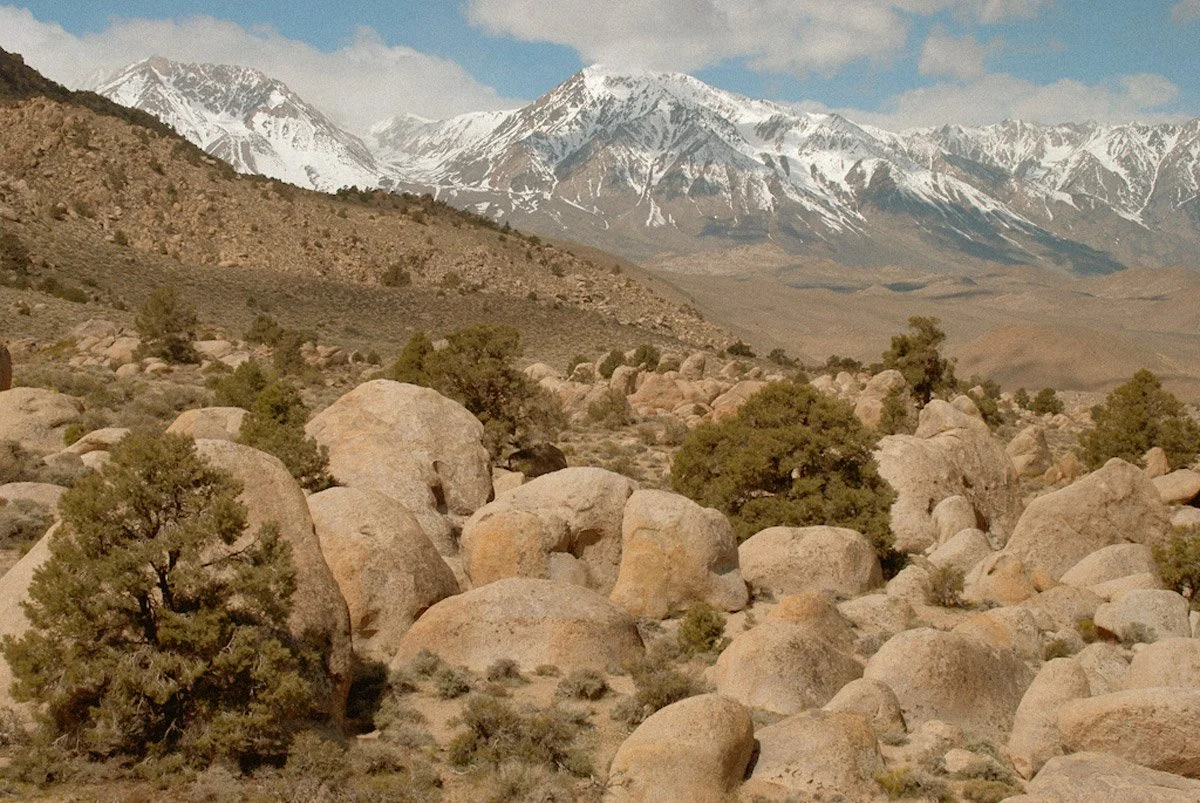
Druid Stones above Bishop with the Sierra Nevada beyond. Photo: jankgo / CC BY 2.0. Cropped and edited.
On very cold or windy winter days, the Happy and Sad Boulders in the Volcanic Tablelands sit lower than the Buttermilks and can offer noticeably warmer conditions. The Happies also provide more shelter from wind in places. A few thousand feet of elevation and a change in exposure can make a meaningful difference during winter.
Warm weather reverses the strategy. Rock Creek and eventually the high Sierra offer cooler conditions as temperatures climb in the Owens Valley.
For a visiting climber, checking conditions across several Bishop areas is often more useful than looking at a single forecast and deciding whether the day is good for climbing.
Planning a Day at the Buttermilks
The Buttermilks remain a relatively undeveloped climbing area, and a little planning makes the experience easier.
Check current conditions. Bishop’s Climbing Rangers publish regular conditions reports during climbing season, including road conditions, weather, closures and current stewardship issues.
Take Buttermilk Road slowly. The road is unpaved and regularly develops washboard and ruts. Snow and heavy weather can make it much worse. The posted speed limit is 25 mph, which also helps reduce dust and impacts on the nearby Starlite community.
Pay attention to parking. Local climbing organizations ask visitors to use established parking and keep emergency access clear. Near Whale Boulder, parking on the south side of Buttermilk Road is prohibited.
Treat highballs as highballs. Difficulty and consequence are separate questions. Look at the landing, use enough pads and competent spotters, and understand how you’re getting off the boulder before committing to a tall problem. Some Buttermilks descents are technical enough to deserve advance attention.
Bring tape and pay attention to your skin. The large grains in the granite can wear through fingertips quickly, especially over several consecutive days.
Choose weekdays when possible. Weekends are busier, and Thanksgiving and New Year’s can bring particularly heavy climbing traffic.
For individual problems, grades and route-finding, use a dedicated climbing guide. The current Bishop Bouldering guidebook by James Lucas covers more than 2,200 problems throughout the region, with a portion of each sale supporting the Bishop Area Climbers Coalition.
Respecting Buttermilk Country
The popularity of the Buttermilks places a lot of people in a relatively small landscape during peak climbing season.
Land ownership in the area is a patchwork that includes the U.S. Forest Service, Bureau of Land Management, Los Angeles Department of Water and Power and Inyo County. Camping rules change with jurisdiction, and camping and fires are prohibited on LADWP property. Established campgrounds remove much of the guesswork.
At the boulders, use the existing toilet, pack out trash and dog waste, stay on established roads and parking areas, and take climbing equipment with you when you leave. Pad stashes and new parking pullouts gradually turn small individual conveniences into larger impacts.
Buttermilk Country also contains archaeological and cultural resources. Artifacts should be left where they are found, and archaeological locations shouldn’t be posted or publicized.
The stewardship issues here are specific to the place: a heavily visited climbing area sharing land with wildlife, cultural resources, several land managers and people who live nearby. The Bishop Area Climbers Coalition works directly at that intersection, making it a useful source for current access information as well as climbing conditions.
Before and After: Two Bishop Stops
A day at the Buttermilks is close enough to Bishop that town naturally becomes part of the routine. These are the two places I tend to stop.
Morning: Black Sheep Coffee Roasters
Black Sheep Coffee Roasters has become a regular morning stop for me whenever I’m staying in Bishop. I usually get a mocha latte — I’m from Los Angeles, sue me — and one of their vegan breakfast burritos. The burritos are great and substantial enough for a climbing morning, although they can sell out quickly. Earlier is better if you want one.
Black Sheep has been roasting coffee in Bishop since 2004 and describes itself as the first coffee-roasting company in the Owens Valley.
End of the Day: Mountain Rambler Brewery
After climbing, Mountain Rambler Brewery is my usual choice for beer and food back in Bishop. I’ve liked all of the beers I’ve tried there, so I’d pick according to whatever style sounds good after climbing.
If you’re there on a Tuesday, check the specials for the nachos. I always get them when they’re available.
Mountain Rambler brews its beer in Bishop and serves a full food menu from its Main Street brewpub.
Bishop Became a Climbing Town
The relationship between Bishop and climbing now extends far beyond the dirt roads leading to the boulders.
Research conducted with the Bishop Area Climbers Coalition and Access Fund estimated that visiting climbers contributed approximately $15.6 million annually to Bishop and Inyo County in a typical year and supported an estimated 127 jobs. Data collection began in 2019, so those figures are best understood as a snapshot of climbing’s economic importance at the time rather than a current 2026 estimate.
The connection is easy to see around town during climbing season. Crash pads fill truck beds and hatchbacks. Climbing shops, guide services, seasonal climbing rangers, campgrounds, restaurants, coffee shops and breweries all participate in an economy and culture shaped partly by people who spend their winter vacations climbing rocks outside Bishop.
The landscape changes again when the climbers thin out. California’s Department of Fish and Wildlife manages 325 acres in Buttermilk Country as wildlife habitat, including migration range for the Round Valley deer herd. Spring brings blooming desert peach, and willow-lined streams provide breeding habitat for songbirds into the warmer months.
Climbing has given Buttermilk Country an international reputation. Its climbing season remains only one part of the year in a landscape that continues changing after the crash pads head for higher elevations.
Gone Buttermilking
More than eighty years separate Smoke Blanchard’s early outings from a busy winter weekend at the modern Buttermilks. During that time, climbing developed a specialized language for what happens on these rocks. Problems received names and grades, crash pads appeared beneath landings, and lines on the Peabodys became known to climbers far beyond the Eastern Sierra.
Smoke’s version was simpler and broader. A day of Buttermilking meant moving through the rocks, finding climbs along the way and treating the boulder field as part of the larger mountain landscape. His friend John Fischer remembered those days in Buttermilk Country alongside much larger adventures because the scale of the objective wasn’t necessarily what made the experience worthwhile.
Modern bouldering asks different things of the same rocks, but Smoke’s way of experiencing the place remains recognizable. Spend a day out there and much of it happens between the climbs: walking through the sage, looking up at the Sierra, moving from one enormous block to another and figuring out where to go next.
FROM THE SHOP
The Buttermilks Climbing Sticker
The artwork behind this Field Note, inspired by the boulders, climbing history and high-desert landscape of Buttermilk Country.
Sources & Further Reading
American Alpine Club — William E. “Smoke” Blanchard, 1915–1989
Primary source for Blanchard’s Bishop climbing history, “mild mountaineering,” and the historical use of “Buttermilking.”
American Alpine Club — William E. “Smoke” Blanchard, 1915–1989Geological Society of America — The Buttermilk Boulders: Glacial Erratics or Rockslide Deposits?
Allen Glazner, Robert Harrington and Arthur Sylvester's 2022 research proposing a rockslide origin for the major Buttermilk boulders.
Geological Society of America — Buttermilk Boulders researchBishop Area Climbers Coalition — Bouldering Areas
Current information on the Buttermilks, access, parking, road conditions, highballs, facilities and stewardship.
Bishop Area Climbers Coalition — Bouldering AreasBishop Area Climbers Coalition — Plan Your Trip
Seasonal climbing guidance, camping and visitor information for the Bishop climbing areas.
Bishop Area Climbers Coalition — Plan Your TripCalifornia Department of Fish and Wildlife — Buttermilk Country Wildlife Area
Historical Paiute use of the area and information about the wildlife area and its habitat.
CDFW — Buttermilk Country Wildlife AreaDoug Robinson — Buttermilk Bouldering History
Firsthand historical perspective on early Bishop climbing, Smoke Blanchard, Bob Blanchard and the Peabody Boulders.
Buttermilk Bouldering HistoryInyo County — Backroad Tours of the Eastern Sierra
Local historical background on Buttermilk Country, including the 1870s dairy and the origin of the Buttermilk name.
Inyo County — Backroad Tours of the Eastern Sierra